
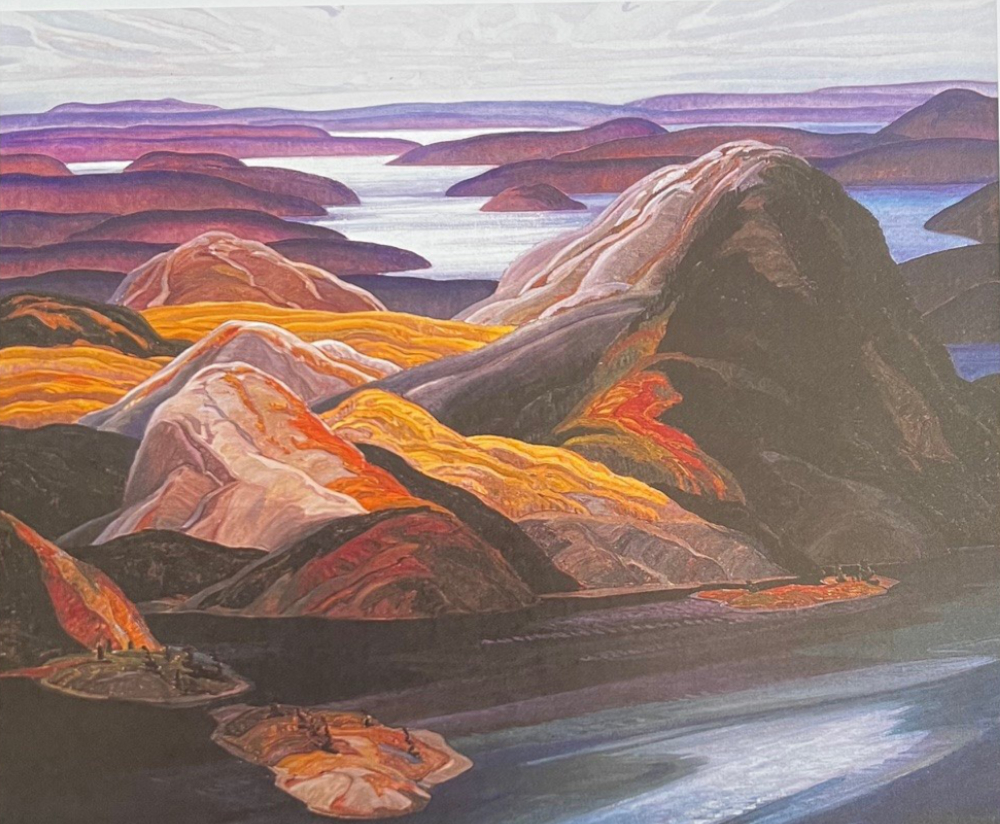
Frank Carmichael, Grace Lake 1931, 8x10
$25
Frank Carmichael (1890-1945) was a member of Canada's Group of Seven. As a teenager he worked in his father's carriage making shop as a striper, decorating the carriages and practicing his design, drawing, and coloring skills. Carmichael and the other members of the Group of Seven were frustrated by their initial attempts to capture the untouched "savage" land of Canada, with the particular characteristics of the land difficult to represent in the European tradition. A.Y. Jackson wrote, "after painting in Europe where everything was mellowed by time and human associations, I found it a problem to paint a country in outward appearance pretty much as it had been when Champlain passed through its thousands of rock islands three hundred years before." It would be only after the group discovered the paintings of Scandinavian landscapes that they would begin to move in a coherent direction.[14] According to J.E.H. MacDonald, the Scandinavian painters "seemed to be a lot of men not trying to express themselves so much as trying to express something that took hold of themselves. The painters began with nature rather than with art." Famous for his watercolors, Carmichael was a passionate landscape painter.[46][47] Many of his paintings depict the trees, rocks, hills, and mountains of Ontario. His earlier works had flat juxtapositions of color, but as he matured through the 1920s he emphasized depth and three dimensional space. Carmichael preferred to depict his outdoor subjects in watercolor. He believed in the independent validity to the medium, and believed them to be equal to oil painting. He said, "It is capable of responding to the slightest variation of effect or mood. It can be at once clean cut, sharp, delicate and forceful or subtle, brilliant or sombre, including all of the variations that lie in between."
Tags
Subjects
lakes and rivers landscape nature
Styles
fine art traditional
Colors
blue brown orange red